
Saturday, 1 June 2013
Dissecting Elizabeth
A cautionary tale, gentleman and esteemed ladies, the following contains spoilers; Proper spoilers that would ruin your experience. Please be advised I don't want to ruin it for you. If you think you'll ever play this game don't read on.

Friday, 19 April 2013
Are you a Girl? Or are you a Boy? Part 2 - Queer
Auntie
Pixelante, creator of Dys4ia notes
that "videogames are one of the few places in life we’re asked
“what gender would you like to be? what would you like your body to
look like?”" In
contrast, her game "exists where that choice does not: it is
seeing the reality that has been shaped around you like a wax cocoon,
and feeling utterly helpless to change it."
 The
game is free and available to play on Newgrounds and documents Auntie's transition to the
sex she has always known herself to be. Whereas in Fallout 3 all that
is required is to restart the game and select a different gender, Dys4ia plays as a series of impossible minigames. They are designed to undermine player choices, so that in playing the
game you experience the barriers that those undergoing gender
transition come up against. The first screen is a Tetris shaped body
unable to fit through the gap provided. Other barriers include
patronising doctors, the search for the right clinic, high blood
pressure and the experience of not having one's gender accepted by
others.
 In
the game, Auntie talks about so called "feminists" who
refuse to accept her as a woman. I have no doubt that she suggests
that their self-identification as "feminist" is undermined by their unwillingness
to support and protect a trans. woman. But in mentioning these women,
Auntie recognises a divide between internally understood gender, and
the appearance of gender to others. In Fallout, as I mentioned in the
previous part of this article, your gender is never challenged:
no-one suggests that you might be trans.
In the real world, the question is asked:
Are you a boy or are you a girl?
 Mattie
Brice, a second trans developer explores the ways in which external forces;
(particularly the male gaze) enforce specific behaviours upon women.
Her game Mainichi is free to download. Initially I played the game
without making assumptions about the player avatar's gender. I couldn't understand
why my protagonist was so anxious to put on make-up and get dressed
up to go for a coffee with a friend. So I milled about the house,
played video games and ate left overs. Only once I leave the apartment and a man verbally assaults me, do I discover that the avatar has a male shaped body. At the coffee shop I feel so anxious and unnerved I don't want to
chat up the cute man at the counter.
 A
second play-through involves baths, makeup and best dress. I saunter
into the coffee shop and get the previously-frosty barista's phone
number. The game clinically outlines that unless I behave according
to societal standards of femininity I will outed as a fake. At the
point at which internally a trans person should feel most
comfortable; when they have moulded their wax cocoon into something
that resembles how they believe themselves to be, they are at their
most vulnerable. In both Mainichi and Dys4ia, gender is the point of
conflict from which the games' tensions spill forth. Each story closes without resolution, Auntie still has to remind people to
call her ma'am, and Mattie Brice has to enact a barbie-fication
in order to find limited acceptance. For them both, their gender
choice is disputed by a society that will not allow them their
convictions. Mainichi and Dys4ia
bristle with frustration.. and this anger gives their personal stories realism and depth. They are games that can't be beaten.
 The
game is free and available to play on Newgrounds and documents Auntie's transition to the
sex she has always known herself to be. Whereas in Fallout 3 all that
is required is to restart the game and select a different gender, Dys4ia plays as a series of impossible minigames. They are designed to undermine player choices, so that in playing the
game you experience the barriers that those undergoing gender
transition come up against. The first screen is a Tetris shaped body
unable to fit through the gap provided. Other barriers include
patronising doctors, the search for the right clinic, high blood
pressure and the experience of not having one's gender accepted by
others.
 In
the game, Auntie talks about so called "feminists" who
refuse to accept her as a woman. I have no doubt that she suggests
that their self-identification as "feminist" is undermined by their unwillingness
to support and protect a trans. woman. But in mentioning these women,
Auntie recognises a divide between internally understood gender, and
the appearance of gender to others. In Fallout, as I mentioned in the
previous part of this article, your gender is never challenged:
no-one suggests that you might be trans.
In the real world, the question is asked:
Are you a boy or are you a girl?
 Mattie
Brice, a second trans developer explores the ways in which external forces;
(particularly the male gaze) enforce specific behaviours upon women.
Her game Mainichi is free to download. Initially I played the game
without making assumptions about the player avatar's gender. I couldn't understand
why my protagonist was so anxious to put on make-up and get dressed
up to go for a coffee with a friend. So I milled about the house,
played video games and ate left overs. Only once I leave the apartment and a man verbally assaults me, do I discover that the avatar has a male shaped body. At the coffee shop I feel so anxious and unnerved I don't want to
chat up the cute man at the counter.

Sunday, 7 April 2013
That's My Nintai!
How to undermine sexism: an indie developer's guide.
Megadev is a small developing team from the South of England. Their latest game is a polished retro platformer with super tight controls. Its enigmatic protagonist has come with a mission, to discover what happened to the one armed ninja who previously made the trip. Armed with trusty katana and shurikens, and trussed head-to-toe in fabric, Nintai Ryoko covers up another subtle secret... her gender.
 There was to be no surprising reveal. Without close examination of the mocked up box art, or perverse scrutiny of her chest area, one might never really register the fact that it's a curious girl who is taking the trip. Intrigued as to why the developers had chosen to develop a female protagonist and then barely lampshade it, I decided to ask what had motivated the team.
At the base of it, it was due to us not having very many female protagonists in our games and we thought it would be more fair remedy [to] that, while at the same time [we decided] not fall into the blatant trope of "sexing it up" for more hits.
Where other developers assume that simply adding a female into their games is enough, Megadev developed its female protagonist who is an exceptional fighter and, as the game's attached comic shows, hungry for a story.
After I asked whether the appearance of the protagonist was designed to be a homage to the Metroid series, the developers replied that: Despite the "classic videogame homage" nature of the game, she was not a direct reference to Samus Aran; however the comparisons are pretty fair as both games tackle the case of gender equality by obscuring the protagonists' appearances with cloth/armour. Simply by hiding her under layers of clothing Ryoko becomes an enigmatic figure. All we can know is that she is a competent fighter, whose motive is what we might use to conceptualize her character.
Megadev commented further that outside of her interactions with Smither the skeleton, her gender is really a non-issue. Smither is the disgusting NPC that sits on treasure levels, asking the player character if she wants "to touch my fibula" and stating that "Ancient evil lies below. My waistline that is." His catcalls ignore the clothes that cover every inch of her body.
So the developers have created a complicated gender narrative by having the player internalise that gender is a "non-issue", and then using an NPC destroy this illusion by focusing only on the character's sexual body. For female gamers, who are so used to having their good gameplay undermined by the sexualised attacks, Smither's words are satirising an everyday reality.
But for those not used to being reduced to a sexual object whilst playing, I hope the SHODN's lascivious skelly provides a wake-up call. Just as they have cleaned up the controls of retro classics, the team have addressed outdated gender-stereotyping. Megadev give the uninformed a taste of what it feels like to be objectified without compromising on engaging gameplay.
Megadev is a small developing team from the South of England. Their latest game is a polished retro platformer with super tight controls. Its enigmatic protagonist has come with a mission, to discover what happened to the one armed ninja who previously made the trip. Armed with trusty katana and shurikens, and trussed head-to-toe in fabric, Nintai Ryoko covers up another subtle secret... her gender.
 There was to be no surprising reveal. Without close examination of the mocked up box art, or perverse scrutiny of her chest area, one might never really register the fact that it's a curious girl who is taking the trip. Intrigued as to why the developers had chosen to develop a female protagonist and then barely lampshade it, I decided to ask what had motivated the team.
At the base of it, it was due to us not having very many female protagonists in our games and we thought it would be more fair remedy [to] that, while at the same time [we decided] not fall into the blatant trope of "sexing it up" for more hits.
Where other developers assume that simply adding a female into their games is enough, Megadev developed its female protagonist who is an exceptional fighter and, as the game's attached comic shows, hungry for a story.
After I asked whether the appearance of the protagonist was designed to be a homage to the Metroid series, the developers replied that: Despite the "classic videogame homage" nature of the game, she was not a direct reference to Samus Aran; however the comparisons are pretty fair as both games tackle the case of gender equality by obscuring the protagonists' appearances with cloth/armour. Simply by hiding her under layers of clothing Ryoko becomes an enigmatic figure. All we can know is that she is a competent fighter, whose motive is what we might use to conceptualize her character.
Megadev commented further that outside of her interactions with Smither the skeleton, her gender is really a non-issue. Smither is the disgusting NPC that sits on treasure levels, asking the player character if she wants "to touch my fibula" and stating that "Ancient evil lies below. My waistline that is." His catcalls ignore the clothes that cover every inch of her body.
 |
| Who are you callin' ninjette? |
But for those not used to being reduced to a sexual object whilst playing, I hope the SHODN's lascivious skelly provides a wake-up call. Just as they have cleaned up the controls of retro classics, the team have addressed outdated gender-stereotyping. Megadev give the uninformed a taste of what it feels like to be objectified without compromising on engaging gameplay.
Thursday, 14 March 2013
Finding the Fun: Sarkeesian and the Joy of Gaming.
As a feminist girl gamer I am occasionally asked what I think of the work of Anita Sarkeesian.
I think that the abuse she has suffered is disgusting. In no uncertain terms the full-scale tantrum of a select few is without justification, and their response has enormous ramifications for the video games industry. Bullies must not be tolerated. Nor does Sarkeesian need to give them a platform, such as a barely mediated comment system on youtube.
In the process of becoming the face of feminism within the games industry, Sarkeesian has counted the ways that misogyny has pervaded video games and found them to pacify women, to to undermine them, to objectify them. She has become hardened, and positioned herself against games... forgetting that games are fun. We play them for fun. We play them to feel like this:

A couple of weeks ago Sarkeesian posted the above picture of her and a friend playing Super Nintendo. On their
faces, the girls have a look of intent, relaxed focus. They wear the half-smiles of gamers who know what they are doing.
For critics of
her work, Sarkeesian comes across as conservative and po-faced. The
school-mistress of video-games who tuts, and says, "it's all very well
and good having your fun but whom are you hurting." Her blog posts
have trigger warnings, her feminist frequency twitter tweets that: Playing games like DmC is the worst part of my job. Remarkable @NinjaTheory managed to cram so many repugnantly sexist tropes into one game... brushing over fabulous, tight gameplay and an impressive aesthetic. By positioning herself as being less interested in gameplay, she detaches herself from an audience that loves games for how they feel to play: Frustrating that game reviewers will often trash games for minor gameplay issues but let blatant misogyny pass without comment.
Without doubt the games industry needs to be shown that the shit they do to women, is uacceptable. But Sarkeesian infers that enjoying the gameplay of inherently misogynistic games is to be complicit with their continuation. The problem is, if I were to review DMC and say "this game is disgusting, but I love how it feels to play", I still paint myself into a sexist corner.
Rather than tread these more complicated lines of inquiry, Sarkeesian chooses to play the role of a hardened, no-nonsense feminist. She is willing to deny herself the addictive and fast-paced fun of a game if it recapitulates tired and sexist tropes. To the defensive and immature, it seems as though she is saying: either continue to play these games and be a sexist, or take my bitter pill for a brighter future. In highlighting only the negatives, Sarkeesian pushes away the very people that need to be questioning and rejecting sexist tropes in games.
In contrast, her personal snapshot is glimpse of the times when she played the games for fun. Until she reconnects with
this focused, invested, and instantly relateable video-kid, she will
continue to be an outsider.
Monday, 11 March 2013
Are you a boy or a girl? Part 1
"I wonder what it would have been like if someone had come along, and in quite a friendly manner had asked, "Well, young one, what do you think you are: a boy or a girl?" What would it have been like not to have been afraid of getting hit because of some wrong answer." - Kate Bornstein
 Unlike Kate Bornstein, when I was thirteen years old I was calmly asked. "Are you a boy? Or are you a girl?" for the first time in my life. And it was to be the first of many times.
The person asking me this was the famous Pokemon Professor, Oak. The screen had gone silent, and the shivers ran up and down my spine. For the first time I was able to choose the gender to which I subscribed, if not by clear choice, by circumstance. When I was thirteen, I traded away my copy of Pokemon Silver along with some choice trading cards for a copy of Pokemon Crystal. I wasn't upgrading to a new model, but rather the trade was motivated by virtue that it was the first Pokemon game to have a playable female protagonist: Kris.
In theory, the gender choice is extremely superfluous in the Pokemon series; passersby say the same things to you, and the world continues in the exact same way as if you were a boy. The in-game mother seems no more anxious about her ten year old daughter setting off into the world, than her ten year old son. Kris is a fairly gender-less tomboy. The different generations of Pokemon games have since presented a range of characterisations of its women: the girls encountered on the road are cool and suave team rockets, or ditzy lasses. Equally. The female protagonists equally range from boyish, to adorable and kooky.
On the surface Kris in Pokemon Crystal plays exactly the same as any male character and dresses fairly similarly; in sensible shorts. But on a personal level, I was thrilled. On screen, was not "Matt", the boy that had gotten me through Pokemon Blue, and Silver and Harvest Moon: Back to Nature. I had played the heck out of those games. Playing Harvest Moon a farming and dating simulator was the happiest hundred hours of my teenage years. But "Matt" was never me; only the character I was pretending to be. Unlike her male counterparts, Kris, was a blank canvas onto which I painted myself. The game was a platform to negotiate my own identity. A chance to really address the first question Pokemon Crystal asked: Was I a boy or a girl?
These days, I often make the choice based on calculations that extend beyond a personal desire to play as a woman. In Bethesda's Fallout 3 there is an infamous "Black Widow" perk, which gives females an advantage over the opposite sex, in a world populated by male enemies. This "game favoured gender" is a useful strategy for gaming developers when it is used to give the gender choice meaning and depth. It is less helpful when it reinforces male physical prowess, or female "healing" proficiency. As games continue to develop, it is possible that gender choice will become ever more nuanced decision, creating difference in game narratives and play styles.
To begin this article I quoted Kate Bornstein. Kate is a male to female transsexual, whose 1994 book Gender Outlaw articulates her frustration at internally associating with one gender, but being exposed as male by others. Videogames offer the opportunity for this internalised exploration. In the safe and virtual world of Fallout's wastelands, no passerby or enemy is going to wonder whether my modest skirts hide a secret. Thus, gender outlaws, can use the virtual world to negotiate and forge an identity for themselves. The characters do not have gender projected back at them: they simply transmit the gender the player chooses out into the world.
In the second part I will examine what happens when video games are conscious of gender narratives. I will examine two fascinating freeware games by transgender women:
Mainichi, by Mattie Bruce
and Dys4ia.
Each of these games explore both the internal struggle, and makes explicit the problems faced once outsiders are given the opportunity to engage in gender narratives, and are worth the ten minutes they take to play.
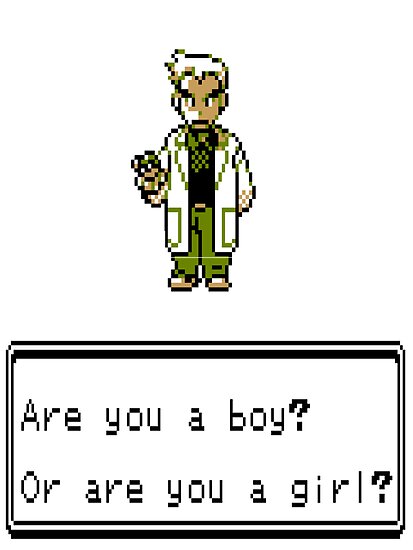
The person asking me this was the famous Pokemon Professor, Oak. The screen had gone silent, and the shivers ran up and down my spine. For the first time I was able to choose the gender to which I subscribed, if not by clear choice, by circumstance. When I was thirteen, I traded away my copy of Pokemon Silver along with some choice trading cards for a copy of Pokemon Crystal. I wasn't upgrading to a new model, but rather the trade was motivated by virtue that it was the first Pokemon game to have a playable female protagonist: Kris.
In theory, the gender choice is extremely superfluous in the Pokemon series; passersby say the same things to you, and the world continues in the exact same way as if you were a boy. The in-game mother seems no more anxious about her ten year old daughter setting off into the world, than her ten year old son. Kris is a fairly gender-less tomboy. The different generations of Pokemon games have since presented a range of characterisations of its women: the girls encountered on the road are cool and suave team rockets, or ditzy lasses. Equally. The female protagonists equally range from boyish, to adorable and kooky.
 |
| The "girl" edition never had an english translation. |
On the surface Kris in Pokemon Crystal plays exactly the same as any male character and dresses fairly similarly; in sensible shorts. But on a personal level, I was thrilled. On screen, was not "Matt", the boy that had gotten me through Pokemon Blue, and Silver and Harvest Moon: Back to Nature. I had played the heck out of those games. Playing Harvest Moon a farming and dating simulator was the happiest hundred hours of my teenage years. But "Matt" was never me; only the character I was pretending to be. Unlike her male counterparts, Kris, was a blank canvas onto which I painted myself. The game was a platform to negotiate my own identity. A chance to really address the first question Pokemon Crystal asked: Was I a boy or a girl?
These days, I often make the choice based on calculations that extend beyond a personal desire to play as a woman. In Bethesda's Fallout 3 there is an infamous "Black Widow" perk, which gives females an advantage over the opposite sex, in a world populated by male enemies. This "game favoured gender" is a useful strategy for gaming developers when it is used to give the gender choice meaning and depth. It is less helpful when it reinforces male physical prowess, or female "healing" proficiency. As games continue to develop, it is possible that gender choice will become ever more nuanced decision, creating difference in game narratives and play styles.
 |
| Take that! Patriarchy! |
In the second part I will examine what happens when video games are conscious of gender narratives. I will examine two fascinating freeware games by transgender women:
Mainichi, by Mattie Bruce
and Dys4ia.
Each of these games explore both the internal struggle, and makes explicit the problems faced once outsiders are given the opportunity to engage in gender narratives, and are worth the ten minutes they take to play.
Friday, 18 January 2013
How to Cook Early Modern Recipes.
Step 1: Choose your recipe.
There are two ways to go: either seek out a popular cookery text of the time on eebo. Here is a short and sweet bibliography to get you started:

Hannah Wooley, The Accomplish'd ladies delight in preserving, physick, beautifying, and cookery. 1675: She has several general manuals, all of which will contain recipes.
Gervase Markham, The Early English Housewife
May, Robert, The accomplisht cook, or The art and mystery of cookery. 1660.
Here is a longer bibliography including latin, italian and french books:
Accessible Manuscript recipe Books:
This is of course a little trickier. You need to have a basic proficiency in paleography. You can search for them on archive hub.
The one I generally use is:
Mary Baumfylde's recipe book and it can be found on British Literary Manuscripts Online 1660-1900. Simply search Baumfylde.
The first half of this book is medical receipts written by Mary Baumfylde in the 1620s, and the second half are cookery recipes written by Katherine Foster in 1707.
Another option is Arcana Fairfaxana Manuscripta,
A victorian facsimile of the Fairfax family's medical recipe book. Most of the book centres on herbal remedies, but around from page sixty-five onwards there are some cookery recipes.
Before you pick your recipe, be sure to consider the following:
- Try to figure out what the recipe will look like. A cheesecake is not the same as a modern cheesecake, but sometimes resembles a steam pudding, what is a posset? Do they mean the same thing when they say bisket?
- What ingredients does it require: Read the whole recipe, there are no ingredient lists.
- Have I got the equipment to make this. This is a skill in itself. Early modern equipment has modern equivalents, be inventive!
- Be flexible. Robert May's recipe for blood pudding suggests that you use the still warm blood of a hog, but you could probably get away with using lukewarm sheep's blood.
 |
| The Cook - Bernado Strozzi c. 1620 |
If you are going savoury, don't feel the need to buy a live pig and flay it yourself. Instead, ask the butcher to help you.
Replace in more delicious equivalent ingredients. I made a currant pudding using a recipe by Katherine Foster, and the currants had small pips, I'll use raisins next time.
Step 3: Weights and Measures.
Use a set of scales that can measure pounds and ounces. (If you even breathe the word cups near me... I won't be held accountable for my actions.)
Step 4: Common sense is your friend.
The recipes you will receive will not be complete. They will not have all the information you require. Having a bit of cooking experience will be a valuable help in this difficult time:
To make an extraordinary good Cake.
TAke half a bushel of the best flour you can get very finely searsed, and lay it upon a large Pastrey board, make a hole in the midst thereof, and put to it three pound of the best butter you can get, with fourteen pound of currans finely picked and rubbed, three quarts of good new thick cream warmed, two pound of fine sugar beaten, three pints of good new ale barm or yeast, four ounces of cinamon fine beaten and searsed, also an ounce of beaten ginger, two ounces of nutmegs fine beaten and searsed; put in all these materials together, and work them up into an indifferent stiff paste, keep it warm till the oven be hot; then make it up and bake it being baked an hour and a half, ice it, then take four pound of double refined sugar, beat it and searce it, and put it in a deep clean scowred skillet the quantity of a gallon, boil it to a candy height with a little rose-water, then draw the cake, run it all over it, and set it into the oven till it be candied.
Take for example this recipe. Clearly, Robert May was cooking for an extremely large household. A bushel of flour is 42 pounds. He literally made a hole in the sack and used that to make the cake. I would suggest dividing the quantities by 20. A mere 900g of flour. Other things worth noting: he ices the cake, but does not tell not tell you what kind of icing to use, or how to make it.
 Finally he covers the entire cake in sugar syrup; something we simply wouldn't do, and then places it back into the oven to harden. The page will be littered with missing information, it's important to have the confidence in your decisions, and just hope for the best. There will be no oven temperatures beyond hot, medium and cool: Look up modern equivalent recipes for good oven temperatures.
Step 5: Use modern equipment.
I'm not saying pull out the food processor and mix it all in there, but if a recipe asks you, as in the case of Katherine Foster's biskett to beat eggs for three quarters of an hour, use an electric whisk. Experiencing material history is one thing; tennis elbow is a different but potentially related thing.
Postscript:
Cooking early modern food is really fun, and can be pretty time consuming. The resulting product, however, is not necessarily going to be delicious; the flavours were still experimental and the processes very much affected by how hot the fire would be at different times of day. Even if you end up with a completely inedible piece of cookery, enjoy learning about the intricate relationship between work and food in the period, and how skill intensive this work was for the men and women who performed it. Take it all in, with a pinch of salt.
Saturday, 29 December 2012
Music and Silence in Botinicula
"Govern these ventages with your fingers and thumb, give it breath with your mouth, and it will discourse most eloquent music."
Hamlet, Act II Scene 2.
Narrative in Botinicula is not told through words via the drawling exposition of the protagonist. Instead every leaf, every insect and monster bristles with emotion, life and characterisation. Embedded in this cacophony is a story about life and death shown through music and silence. Life is articulated as creativity which is fed to the player through the sounds and music of this beautifully orchestrated game. Every leaf that the mouse brushes over has a sound that tinkles, as though the cursor was itself an intergral part of the eco-system. The player's actions seem to breathe life into the game, which in turn becomes an instrument. Silence is death.

The protagonists are five small creatures, three of them are types of seed; Mr. poppy head, Mr. Lantern (he looks like a hazelnut or acorn to me), and Mr. Feather, ( a sycamore seed). The fourth critter is Mr. Twig covered in tiny buds and the final, Ms. Mushroom (marital status unknown, and considering that mushrooms can produce either asexually, or sexually this seems appropriate). The gendering of these characters is simply a tool of anthropomorphism, as little narrative is given to the relationship between the protagonists. Instead these creatures each represent the continuation of life as they carry not only the desire to protect life but the potential to create, regrow and repopulate. In contrast, the antagonists are black spider-like blobs that pump life out of the trees wasting the resources to asexually produce a consumptive population.
As this trailer shows there are unfriendly creatures in the ecosystems, but these natural predators are contrasted with the villains which rot and destroy the trees themselves. The buzzing beetle articulates a natural hierarchy whilst the silent, stealthy monster spider destroys the ecosystem. The musical atmosphere which is so lively is replaced by silence once the spiders infiltrate. Botinicula's narrative is therefore nuanced enough to not articulate a moral world, but the only honest struggle; between life and death.
 |
| Saving the world can wait ^_^ |
In one room the player enters to find piles of dirt. When they are clicked, small shoots grow and produce buds. On the end of one bud forms a beehive, which pollinates the flowers. One of the flowers climbs higher and produces a landscape, and then a further flower becomes a mini hot-air ballon which carries a tinycreature up the landscape. Clicked on again, the critter gives the player a flower which leads to the completion of part of a mission. The room is a microcosm for the game, which in turn suggests that the seemingly random actions of the player can set in motion, and develop beautiful systems. Were I teaching secondary Biology, Botinicula would be on the syllabus.
As the game pushes you into the darker recesses, the root system, a series of errands are created. Rather than instigating a final solution, these puzzles seem to suggest that there will be no escape. They offer instead small comforts. One creature has lost his trumpet, another, the small orb that brought him light. As the game grows darker, it imposes the hopelessness of the task. Even if I do find that trumpet, how will I ever stop the impending destruction of these myriad lives, all for the purpose of the growth and consumption of a single species.
 |
| But we can just plant more trees! Right? |
Monday, 26 November 2012
Greg Rucka's Post 9/11 Pin-ups.

In the opening gambit to Greg Rucka's Queen and Country, Tara Chace sits poised for her first hit. Freezing and exhausted, her target; a Russian General the American's want dead, slides out of a car. Tara fires a single bullet straight into his skull and thrusts her frozen bones into the shadows. Moments later she is spotted and makes a break for it, cue chase sequence, bullet to the leg, then eventual escape. The cold seductive killer, watches, destroys, then slips away into shadow. That should be the end of it.. but upon return to London the mission, which was simply a favour for the CIA, has lost any shimmer of glamour. Her first kill was meaningless when it should have been for Queen and Country.
Batwoman: Elegy tells the story of a disgraced twenty-something dismissed from the military academy that had promised vengeance. Kate Kane is a vigilante super-heroine. In the opening glossy two page spread Batwoman has her sensible red boot pressed against a young man's throat. "You know what I want Rush" Her shocking red lips against her grey-white skin are a wound and a threat. "I want your secrets, I want where and I want when, I want her name. And you ... really... want to give it to me." This emphasis bristles with sexual tension, she is the potential dominatrix, ready to punctuate her questions with the brutal work of her fists.

But the cliched questions and the overblown dialectic suggests that she is new to the role... This is outlined beautifully in an article by Q Magazine's Colin Smith. Referencing the moment she meets Batman, He writes:
 |
For Smith, Batman's assured competence (READ: white, wealthy hetero-normative power) sits in stark contrast to Kane's approach to vigilantism which is fueled above all by anger. When Kate's father discovers a cache of weapons she has stolen from his barracks he informs her:
"I was actually relieved when I realized what you were doing with all this stuff. But here's a little biscuit for you to chew on, Kate. You're not a soldier anymore, and you're not a cop. Just because you survived beast at the point and you were senior elite in gymnastics doesn't mean you're a damn crimefighter and its going to stop now."
His anxiety is gendered. Jake Kane highlights his daughter's feminine achievements: the moment she survived the attack of "beast" referencing a potential rape, and her talents in gymnastics. In so doing, he airbrushes over his daughter's successes in military school. Only once Kate informs him "I've found my way to serve", proposing that the work will bring direction and discipline to her life, does Jake Kane accept her decision. His attempts to undermine her plans give her a platform to explain the decision. Rucka filters her personality through several layers, purposely weaving a narrative that shows more how others respond to Kate, rather than asserting and reasserting her core values. The following double page spread, stunningly produced by artist J.H. Williams, reiterates the reference to gymnastics.
 |
| Also she's a keen trainspotter. |
 In contrast, Tara Chace is unbending, determined, masculine and, as a result, brittle. Running on empty, Chace freezes, gets into fixes, gets shot, and above all is driven almost mad by the bureaucrats in London and undermine her decisions and treat her as a commodity. Following being attacked and electing to CHARGE at him like bloody lunatic Chase is chastised by Mister Kinney; a higher up. "You! Chace! I want an answer by God! You stupid Bitch! Your orders were to draw them out, not to engage!" She is visibly exhausted, fag in mouth, the adrenaline having ripped through her. In a rage, she passes him "You have a problem with my performance, you're free to take it up with D-Ops.... at which point I'll be delighted to tell the home office about how you arrived just after the nick of time." The next time they meet, Chace is given a chance to explain her decision. [left] She smiles. "Next time you find someone shooting at you... and you're unarmed, try running towards the shooter" Then scowls "And pray the shooter isn't me."
Colin Smith, in his review of batwoman opens :
It's impossible to say whether "Batwoman: Elegy" is an angry comic book that's been written by an angry man.
But I strongly suspect that it is.
 |
Not only is Rucka angry, but Kate Kane is furious and Chace, livid. In both series this anger is given meaning by the discrimination it responds to. Chase crumbles under the pressure of fulfilling the masculine role of spy, whilst being undermined by her female body; which gives scumbags like Kinney the opportunity to call her anything they want, undermine her decisions and insinuate that she is unable to cope with war. The female body takes the brunt; Chace self-medicates alcohol, cigarettes; whilst the brutal work of the active spy, and the stress and the strain of London politics additionally take their toll. The final panel of her time in the series shows her body dealing the final blow to active service as she sits holding a positive test for pregnancy. The battleground of Queen and Country is located not in Afganistan, Iraq, or in London, but in Chace's body which is devastated by active service. Despite this, Rucka does not suggest that Chace is unsuitable for active service, but rather that her female body impacts how the men around her respond to her work. It is society's perception of the woman at war which eventually destroys her career.
Kane on the other hand is removed from the army when she admits she is a lesbian.She removes herself from the institution that would seek to undermine her by choosing vigilantism. This choice allows her to experiment sexually and lose control of the stark and austere persona she had pursued in military school.
 |
| Another torn apart female body. |
Saturday, 3 November 2012
The Delicious Deadly Delight of They Bleed Pixels.
They Bleed Pixels is a dangerous and exciting game. The music drips with threat as you load up for the first time and see, in lo-fi graphics, the arrival of a strange emily to an austere school for girls. She discovers an evil book and having read it, is plagued by evil dreams with literary epigraphs.
The epigraphs reference not only H.P. Lovecraft's works from which the Victorian horror theme is drawn, but takes snippets from writers such as, Edgar Allen Poe, China Mievelle, and Phillip Pullman. These provide exposition for each coming level. These screens provide players with a literary bookshelf, which can extend and enrich the experience provided they are willing to look beyond their computer screens. Furthermore by having a different author, and with it a different platforming setting, whether it is underwater, in hell or Japanese lanterns, makes each new level seem like a new book. Entering these levels turns a new leaf, a new experience, and thus we mimic the curiosity of the protagonist when she opened the dark and terrible book that is now sending her visions.
In the dreams the young girl is transformed. Her arms become sharp tuning-fork shaped claws, and the game forces her to use them to inflict damage on the shadowy monsters that threaten to kill her. Initially the transformation is shown as a liberating and dangerous experience. She levitates, her arms grow and change into razor sharp weapons and simultaneously a smile grows sadistically across her face.

Then the gameplay kicks in and this sadism, delight and liberation is tainted by the reality that she has been thrown into a brutal horror setting. Littered with saw-blades, deadly and fast enemies each stunning landscape seeks to mutilate and murder her. As players, whatever pretensions of success we might have are reined in by a simple combat and platforming style that expects perfection and punishes the slightest mistake. A bit like going to boarding school then?
The gameplay mimics the polish and precision of Super Meat Boy, an insanely tricky game which encourages premature death but counteracts it with quick reloads, and fast pacing. Both games encourages not the sadism of the player, but their masochism as they repeatedly throw themselves against spikes saw-blades and enemies. Thus They Bleed Pixels alters the central dynamic of the game; the protagonist's transformation which the player initially viewed as liberating, mutilates the young girl's body and sets her up for a series of violent deaths.

When she awakes from each excruciating dream, in which she will have died over and over, she tries to elaborately rid herself of the book, burying it, throwing it in a river and burning it. But it returns again to haunt her revealing that the escapism is the means of controlling her.
A friend recently told me that to play games such as these was an exercise in futility. Unless I improve my platforming to a level where I might be able to complete the game I will never have the satisfaction that is provided by a myriad of other more mainstream titles. Each year, a new Call of Duty title reproduces a fantasy of masculinity, which delivers the player the sense of completion and coherence that connects the physical prowess of the male body to the desire of the player to dominate. But in They Bleed Pixels: a game that foregrounds the inevitability of the characters repeated death no sense of coherence is possible.
Yet the player returns again and again to masochistically inch their way through the levels because they want to find the ending. In order to do they must do almost exactly what the game wants; hitting each button in a perfect sequence. At the end of each level, any feeling of empowerment is tainted by the reality that they survived because they did what the game told them to do. The liberation of this victorian, female character is tainted by the reality that her every action is controlled by the menacing terror of the dream-scapes. Her search for identity is futile; as the road to it is coated and slick with her blood.
---------------------------
A short post script.
This game is ridiculously fun! The bonus levels are fabulous, including a child-drawn level called "They Bleed Ponycorns" which is adorable, and the new "All Hallows Eve" level which was a free add-on for all customers, new and old and really really brilliantly done! A* Business Practice.
 |
In the dreams the young girl is transformed. Her arms become sharp tuning-fork shaped claws, and the game forces her to use them to inflict damage on the shadowy monsters that threaten to kill her. Initially the transformation is shown as a liberating and dangerous experience. She levitates, her arms grow and change into razor sharp weapons and simultaneously a smile grows sadistically across her face.

Then the gameplay kicks in and this sadism, delight and liberation is tainted by the reality that she has been thrown into a brutal horror setting. Littered with saw-blades, deadly and fast enemies each stunning landscape seeks to mutilate and murder her. As players, whatever pretensions of success we might have are reined in by a simple combat and platforming style that expects perfection and punishes the slightest mistake. A bit like going to boarding school then?
The gameplay mimics the polish and precision of Super Meat Boy, an insanely tricky game which encourages premature death but counteracts it with quick reloads, and fast pacing. Both games encourages not the sadism of the player, but their masochism as they repeatedly throw themselves against spikes saw-blades and enemies. Thus They Bleed Pixels alters the central dynamic of the game; the protagonist's transformation which the player initially viewed as liberating, mutilates the young girl's body and sets her up for a series of violent deaths.
When she awakes from each excruciating dream, in which she will have died over and over, she tries to elaborately rid herself of the book, burying it, throwing it in a river and burning it. But it returns again to haunt her revealing that the escapism is the means of controlling her.
A friend recently told me that to play games such as these was an exercise in futility. Unless I improve my platforming to a level where I might be able to complete the game I will never have the satisfaction that is provided by a myriad of other more mainstream titles. Each year, a new Call of Duty title reproduces a fantasy of masculinity, which delivers the player the sense of completion and coherence that connects the physical prowess of the male body to the desire of the player to dominate. But in They Bleed Pixels: a game that foregrounds the inevitability of the characters repeated death no sense of coherence is possible.
Yet the player returns again and again to masochistically inch their way through the levels because they want to find the ending. In order to do they must do almost exactly what the game wants; hitting each button in a perfect sequence. At the end of each level, any feeling of empowerment is tainted by the reality that they survived because they did what the game told them to do. The liberation of this victorian, female character is tainted by the reality that her every action is controlled by the menacing terror of the dream-scapes. Her search for identity is futile; as the road to it is coated and slick with her blood.
---------------------------
A short post script.
This game is ridiculously fun! The bonus levels are fabulous, including a child-drawn level called "They Bleed Ponycorns" which is adorable, and the new "All Hallows Eve" level which was a free add-on for all customers, new and old and really really brilliantly done! A* Business Practice.
 |
| Rank D? Just ONE MORE GAME. |
Wednesday, 24 October 2012
I've just been TO THE MOON
Just completed freebird games' "To the moon" an atmospheric point and click narrative adventure (Not so much a game, as an interactive book). It was really confusing, because time leapt about, so no real post today, just a quick note to say: This game is really really interesting and I think you should probably play it because it is creepy and quirky and a little pretentious, and made me cry real tears.
Trailer posted so you can enjoy the fab music. *sigh* OK Fan girl gushing over!
Post script: This game contains another crazy woman! I'm really gonna have to make a bingo card for video game characterisation of women. This one handles it as subtley as The blackwell conspiracy, and its a really key plot device. I feel another post coming on: for another night.
Wednesday, 10 October 2012
Etiquette
I'm offended by all of the supposed-tos. I don't like women telling other women what to do or how to do it or when to do it.
-- Jessa, Girls
Trawling through a charity book shop I come across a sociological texts that was published in the 1980s. It uses yellows, and blacks and whites and is called something like: female voices or traumas of single womanhood or the vagina dialogue. It is a collection of narratives about women. I point it out to mum, and she glances at it and laughs, saying, I read all of those, "I read them all until one day, when your brother was five or six I read that I really should send him away to live somewhere else, because once he hits eight years old, he'll start oppressing women. And I thought, what a load of bollocks." She gave up on reading the guidelines, and lived an albeit feminist lifestyle without adhering to all of the prescriptive writing.
When Jessa, from the HBO TV show Girls is told by a book that sex from behind is degrading, she shrieks: "What if I want to feel like I have udders". Her outburst seems peculiar at first but then reveals the underlying problem that feminism has become a second set of prescriptive writing that tells women what they should be, what they should want and what form their sexuality should take. "Bad Feminism" by Roxanne Gay voices the frustration of an on-the-fence feminist: "I keep reading these articles and getting angry and tired because these articles tell me that there's no way for women to ever get it right. These articles make it seem like there is, in fact, a right way to be a woman an a wrong way to be a woman. And the standard appears to be ever changing and unachievable." Frustratingly this punchy closer is followed by a list of things she feels she gets wrong, so she subscribes to the idea that there is indeed a right way, and she falls short of it. Gay reinforces the stereotypes of extremely outdated feminism perpetuate: that sex must be a certain way, that women must be militant, that they must hate pink... etc. etc.
I too have felt the stress and the strain that Gay articulates, but I realised that I didn't care if a handful of people, men, women, feminists or not were offended by my particular sexuality, penchants and tastes. Furthermore, I don't mind being told what to do sometimes. I enjoy articles which tell me of a new thing I need to think about, because I still have a mind, and a choice which allows me to construct a nuanced and relativistic approach to feminism. Roxanne Gay is wrong to assume there is a right way to be a woman, or even a right way to be a feminist, since both the gender and movement are forums open to discussion and negotiation. A place to toss your two cents, and then carry on regardless, because feminism suggests you should be able to justify exactly what makes you feel comfortable and happy as liberation; provided it doesn't hurt others.
--------------------------------
Post Script on Video games.
What do women want from female protagonists?
My Two Cents: I want lots of them, I want them to be all kinds of different types of women. I look at Bayonetta and I think yeah: interesting. But that's been done now, can we have something else. Something different. Another refraction, a different collection of tropes, beliefs, fantasies, and shapes. Please? Pretty Please?
 |
| In case you were wondering: This is Bayonetta kicking someone with a giant stiletto made of her own hair. |
Monday, 24 September 2012
No Girls Please: Gender Stereotyping in Indie Games.
In Critter Crunch, an extremely polished puzzle game from publisher Capybara Games, there are three characters. First the game is introduced by a nature documentary presenter slash explorer. Having discovered the unique eco system of the island, he delights on explaining the critters habitats and behaviour. He then goes on to introduce the puzzling central protagonist; a rotund and furry critter called Biggs, and the progeny of that creature called smalls. Each of these critters could have been genderless, but the writers make it clear that this hunter gatherer creature is a father looking out for his son. So within the first two minutes of the gameplay; the exposition has been carried out, and two squashy main characters have all been represented as arbitrarily male. This may seem like a moot point as it doesn't affect gameplay directly; it could even be a nice twist on how we perceive caring for children, but as the developer makes no explicit attempt to explain the gender choice for any of the main characters it comes across as lazy or sexist design.
The male characterisation seems decision that boys play video games and therefore they will want to be the protagonists in this adventure. Furthermore, the central mechanic of the parent - child relationship is that the father gathers food, and when there is a long combo, you get the option to “barf rainbows” into your waiting child's mouth. Perhaps it was deemed inappropriate for women to regurgitate food, it's not as if children take liquid from women's bodies both in the womb and from the breast after. Sticky fluid is certainly not something we want to associate with the female form: that would be indiscreet. Intention, is of course a dangerous thing to write about, and though I was tempted to email the publisher, I felt aware that I might come off as blinkered, when really I want to improve video game story telling. If the producers of the game had explained the decision, I think I'd be able to swallow it. But I felt disappointed that this puzzle game could have shown an interesting series of relationships, instead chose to build a game that would appeal predominantly to little boys.
 |
| Wait where are the balls in this diagram? |
From the excitable, and parachuting adventurer, to the father-son combo, the game glibly assumes the only possible audience for this otherwise interesting, colourful and appealing puzzler will be male. Added to that it seems to share the assumption that boys will only associate with male characters, which has long been held by producers of children's television programming. In recent years however with the break-out hits of My Little Pony: Friendship is Magic, a show that has developed an enormous fanbase amongst young men (aged 16-25) and with the newest season of the Avatar kids television franchise: The Legend of Korra. The latter show was only given a ten episode run as the network was extremely anxious that young boys would be unable to connect with it's eponymous female protagonist. The show was an enormous hit and now has 40 episodes in the pipeline. Boys and girls connected with the Korra and this hopefully made bosses sit up and listen to the idea that boys will watch girls if the story is good enough.
 |
| omnomnomnomnom |
 |
Indie game developers obviously still have to find a market for their games, but they do not have to pander to scared, sexist and outdated publishing practices. Capybara games are not alone in their particular decision perpetuate arbitrary gender characterisation. For the most part developers choose a male protagonist and this is not always problematic, but the decision becomes particularly noticeable when the player character is in fact an object. In the platformer Nimbus, you play as a bullet shaped space-ship that has no means of internal propulsion but floats using gravity and air streams. The little spaceship is not manned, apparently, but a sentient creature with, you will be surprised to hear... a pink girlfriend space ship. In the opening cut-scene, the two little space ships are having a moment of fun, when an evil eye plucks the helpless pink robot out of the sky and laughs maniacally. The perfect expression of lazy design, the developers hark back to retro platformers without considering how problematic this stereotype is.
Nimbus could have used it's beautiful air mechanics to show objects falling space and showcased what makes this platformer unique. Puzzle games have every right to pare down on narrative through cut scenes, if they don't have the resources to carry them out. But when effort and time has been put into recreating the tired princess-kidnap trope, I am left wondering how that time might have been better spent. When developers cut narrative corners they inevitably rearticulate dominant paradigms, they fall into mediocrity and innovation is tainted. It's a shame, because interesting mechanics and concepts deserve polished stories that say SOMETHING, rather than repeating the small nothings of every slip-shod game that has preceded it.
 |
Sunday, 9 September 2012
Blackwell (Series) and the Female Legacy.
*Spoiler warning* This post contains spoilers. It will ruin your gaming experience, but those spoilers are necessary to explore the gender narratives of this excellent collection of games. So if you don't think you will play, you're not interested in point and click, or want to read my analysis anyway, read on gentle traveller. p.s. Most of the spoilers come from the first game in the series: The Blackwell Legacy.
[Trailer]
The Blackwell series is a collection of four point and click adventure games which trace the relationship and life of Roseangela Blackwell and the ghost that has haunted the women in her family for three generations. The game begins with Rosa scattering the ashes of her aunt, who, we learn later, was the previous host to smooth-talking 40s ghost Joey. Her voice is monotonous, and if you watched the trailer, like me you may have laughed at the opening line delivery by her voice actress. But as the game begins you quickly realise that her monotonous drawl is an intrinsic aspect of the disillusioned new yorker's personality. Rosa is anxious, she is shy, she is not charismatic and so the monotony of the voice is the culmination of these aspects. In a commentary that comes with the game, the writer Dave Gilbert compliments a colleague who animated Roseangela's walk, noting that she looks slumped and lazy; her walk is as hesitant as the character to whom it belongs.
Her isolation is illustrated by the games opening puzzle; a punk-ass teenager mans the door to her apartment, and refuses to let her in, because he knows everyone in the building, but he doesn't know her. From the players point of view, entering into a game about ghosts and spirits, you imagine shenanigans are afoot. Is she dead? Is this a dream? Is this kid pranking her? But it turns out that he simply doesn't know her, despite her living in her current apartment for several years. A freelance writer, Rosa, seems to fit a stereotype of a recluse. But then even this representation of an ordinary, dumpy, awkward woman as a protagonist of a video game is innovative.
As the game gets into full swing Joey appears, explains that Roseangela will be haunted the rest of her life, and that she must help restless spirits pass by solving the mysteries surrounding their deaths. Roseangela and Joey have a tense relationship which carries through several hours of gameplay without being resolved. Occasionally the ghost is flirtatious, occasionally cruel, and consistently his overt 40s sexist names, "doll", "kid" and "sweetheart", invade conversation. Joey is the vehicle that forces Rosa out of her apartment and into the adventure. To begin with he berates her, but they develop a more equal partnership once Rosangela appears to accept the role that she has been given.
At times, Rosa enjoys the ghost hunting, but this enjoyment is consistently overshadowed by the fear that she will, like her aunt, go insane. This is the threat that pushes her into ghost-hunting since the insanity is always articulated as a lack of acceptance of the role forced on them by Joey. Insanity pervades the first three games as a consistent theme set against the theme of death. Indeed for most of the characters that Joey and Rosa encounter one of two fates is laid before them: madness or death.
There is strong emphasis on the fact that Joey haunts only the female members of the family. Perhaps therefore he represents a particularly gendered form of madness. He frequently, terrifyingly, threatens his host that IF she reveals his existence she WILL be locked up in a loony bin, and that he will make her life a living hell. However light Rosa makes of these threats the game uses the achievement system (steam) to reinforce them. "Crowd Control" is awarded if you never speak to your ghostly friend in the presence of another character.
 Blackwell Unbound is the second game in the series and it follows Lauren's (Rosa's aunt's) time with Joey. The game is sad. Throughout you know of Lauren's unhappy ending in the mental asylum. Within the game, as the trailer shows, Lauren is warned that she "may die". "Oh, is that all?" she replys. Ironically it is the insanity that she fears which is to be her fate.
In placing the two female protagonists in this bind; with only a choice between ghost hunting and insanity, Dave Gilbert creates an interesting narrative about female fear and agency. Rosangela certainly is a character who prides herself on clarity: a freelance reporter her intelligence and analytic skills are the source of her self-esteem (limited though it is). Thus she takes more pride in working out how to drug a neighbour's dog than in having established a friendship with that neighbour in the first place. Not making sense and loss of agency is far more threatening than isolation. Joey has removed the majority of that agency, so little wonder that the Women in Rosa's family have fallen into madness. Incoherence is a particular fear for a well-educated, probably (ambivalently) feminist, character. Aware and frustrated that there is a "Legacy" of madness amongst women in her family, Rosa has over-compensated.
Another legacy emerges. If we consider literature and women's history, we stumble upon other narratives of the female search for clarity, and for being taken seriously. The Yellow Wallpaper by Charlotte Perkins Gilman. The story traces a young woman who under the rest cure stares at patterns in the wallpaper, and in them she finds her own form of clarity but in the process goes insane. Outspoken women, difficult women, angry women, frustrated women, have through the century been derided, laughed at and considered insane by those around them. In my family, we have our own legacy of female madness. By which I mean, my granny was difficult, my mother is emotional, and I am both. Rosa's visceral fight to maintain coherence, despite her paranormal activities, is her fight against the supposed hysteria that has plagued her family.
Typically in videogames, the central aim is to not die. The choices you make have consequences that will or will not lead you to death. If you fail to jump here, or you miss the quick-time event there, then the consequences for your character will be a swift and painful death. In the context of a point and click, especially this one, the only consequence for failure is not progressing with the narrative. In this regard, the fear of loss of agency is elegantly placed in a point and click character; because failure leads to stasis; not unlike the rest cure that Aunt Lauren suffered. By using the frustration of point and click to articulate Roseangela's working role, Gilbert demonstrates that her sarcasm, her irritable personality and her self-imposed isolation might have deeper feminist anxiety driving them. The fear of being incoherent.
[Trailer]
 |
| That's a ... pretty severe attitude, wouldn't you say? |
Her isolation is illustrated by the games opening puzzle; a punk-ass teenager mans the door to her apartment, and refuses to let her in, because he knows everyone in the building, but he doesn't know her. From the players point of view, entering into a game about ghosts and spirits, you imagine shenanigans are afoot. Is she dead? Is this a dream? Is this kid pranking her? But it turns out that he simply doesn't know her, despite her living in her current apartment for several years. A freelance writer, Rosa, seems to fit a stereotype of a recluse. But then even this representation of an ordinary, dumpy, awkward woman as a protagonist of a video game is innovative.
As the game gets into full swing Joey appears, explains that Roseangela will be haunted the rest of her life, and that she must help restless spirits pass by solving the mysteries surrounding their deaths. Roseangela and Joey have a tense relationship which carries through several hours of gameplay without being resolved. Occasionally the ghost is flirtatious, occasionally cruel, and consistently his overt 40s sexist names, "doll", "kid" and "sweetheart", invade conversation. Joey is the vehicle that forces Rosa out of her apartment and into the adventure. To begin with he berates her, but they develop a more equal partnership once Rosangela appears to accept the role that she has been given.
 |
| So a ghost walks into a bar... |
There is strong emphasis on the fact that Joey haunts only the female members of the family. Perhaps therefore he represents a particularly gendered form of madness. He frequently, terrifyingly, threatens his host that IF she reveals his existence she WILL be locked up in a loony bin, and that he will make her life a living hell. However light Rosa makes of these threats the game uses the achievement system (steam) to reinforce them. "Crowd Control" is awarded if you never speak to your ghostly friend in the presence of another character.

In placing the two female protagonists in this bind; with only a choice between ghost hunting and insanity, Dave Gilbert creates an interesting narrative about female fear and agency. Rosangela certainly is a character who prides herself on clarity: a freelance reporter her intelligence and analytic skills are the source of her self-esteem (limited though it is). Thus she takes more pride in working out how to drug a neighbour's dog than in having established a friendship with that neighbour in the first place. Not making sense and loss of agency is far more threatening than isolation. Joey has removed the majority of that agency, so little wonder that the Women in Rosa's family have fallen into madness. Incoherence is a particular fear for a well-educated, probably (ambivalently) feminist, character. Aware and frustrated that there is a "Legacy" of madness amongst women in her family, Rosa has over-compensated.
 |
| There is a recurrent spot where the pattern lolls like a broken neck and two bulbous eyes stare at you upside down. |
Typically in videogames, the central aim is to not die. The choices you make have consequences that will or will not lead you to death. If you fail to jump here, or you miss the quick-time event there, then the consequences for your character will be a swift and painful death. In the context of a point and click, especially this one, the only consequence for failure is not progressing with the narrative. In this regard, the fear of loss of agency is elegantly placed in a point and click character; because failure leads to stasis; not unlike the rest cure that Aunt Lauren suffered. By using the frustration of point and click to articulate Roseangela's working role, Gilbert demonstrates that her sarcasm, her irritable personality and her self-imposed isolation might have deeper feminist anxiety driving them. The fear of being incoherent.
Thursday, 6 September 2012
Indie Games for Girls (and Boys) Introduction
Blackwell: Excellent Games for Girls (and Boys)
So there was This interesting article on the Mary Sue about upcoming releases. It is a list of anticipated triple A games that were due for release that might be interesting to the Mary Sue's predominantly female readership. I was pleased to see that they went for the games with guns, the games that are typically not placed in women's demographic. I was just a little disappointed by the lack of indie titles, though they did include "Torchlight 2". So this post is probably going be part of a series of reviews and previews of existing indie titles, through my inevitably rose-tinted glasses. I'll start with the Blackwell games, a series of point and click adventures so good they were worth playing twice. Then in upcoming articles I'd like to cover, The Binding of Issac, a game I have sunk seventy hours into (and counting) and perhaps I'll do a couple of shorter articles on interesting titles and the problems they encounter when they use gender in their titles Nimbus, Hamilton's Great Adventure, and Dangerous High school Girls in Trouble. In each case I hope to interrogate the gaming industries stereotyping of female characters and explore the claims that female characters are under-represented or poorly characterized.
My decision to look at indie games is two-fold. First this is a less well trodden path; fewer people look at indie games as a medium. Secondly, indie games are not constrained by the barriers placed on games produced by established publishers. Without the marketers and businessmen's input, in theory, these video games should represent a wider selection of female characters. My aim with these reviews and articles is wonder at how games now are representing women, and to consider exactly what makes for decent female character development, and what is the result when bad characterization enters games.
Are women playing the major roles?
How interactive are female characters?
And, especially important, how do game mechanics delineate gender?
Video games are medium unto themselves. By exploring the specifically interactive modes that these games use to articulate gender, I will be able to show how games should be designing female characters to depict their strengths, and their weakness in ways that cohere with game mechanics, art design and characterisation.
Tuesday, 15 November 2011
All My Little Ponies. (What d'ya mean red dead ain't a riding sim?)
The Horses in Skyrim are shit.
I understand, horses and ponies are hard to animate, and almost impossible to balance. Having played skyrim for a couple of hours only I managed to amass the 1000g needed to buy a very beautiful stocky nord horse. It was beautifully animated, and stood in it's pen behaving as I have seen real horses do. It made the right noises, it moved in the right way and I WANTED IT. I had had bad experiences with in game horses before so I saved before buying her, climbed aboard allie and watched to my dismay as she walked at human speed and sprinted slower than my character could. Crap. A reload then. Added to this, riding instantly forced me to go into third person, so all the practice I put in was useless. I couldn't use a two-handed weapon whilst riding, so my beserker was essentially slowed and disarmed all because I was silly enough to try and ride a horse. I do however understand bethesda's logic. Horses are powerful. In game there is the option to steal the animals. If they went too fast the thief would be unstoppable, so instead the horse becomes as useless as the famed 'horse armour' of Oblivion.
All in all I give the Skyrim horse 3/10.
There are at least two ways to counteract this discrepancy, one is to time-lock the horse until you reach a certain level or you play for a certain amount of time. This was the method used in Harvest Moon: Back to Nature. Not only was this the best version of the farm simulator it had one of the most balanced in game horses. You can receive your steed simply by activating an event in the first month of your arrival at the farm. The animal is brought to you by a neighbour but is too young to be ridden. So for one in game year ( around 25 hours of playtime) you must tend to the foal, brushing him everyday so that he loves you. When next spring comes around if your neighbour is pleased with the horse's progress he gives him to you. In this way, the instant excitement of having an animal on your farm is coupled with the waiting game in which you grow attached to all its pixels. This tending process is rewarded with a horse who can not only be ridden but also acts as a moveable shipping box which allows the crops you harvest to be sent to the buyer (Really useful in game). The horse also unlocks a horse racing mini-game to be played once a year. The soft-lock on the horse is perfectly designed to be as satisfying as possible to the player and in the end getting the steed feels like a reward for the love and attention you put in.
8/10
Another method of locking out a horse from the game is to control the rarity of good horses. This is illustrated brilliantly by Red Dead Redemption. Red dead is easily the best horse riding simulator I have ever played. I understand that other people played it for the action, the story and the adventure and whilst all of those things were great it was the horses that kept me playing in the closing acts of the game. Once I had completed the main story I stopped fast travelling altogether. I rode and rode and rode the length and breadth of that country, because it was more fun than fast travelling. The horses were balanced, only by unlocking new areas would new breeds reveal themselves, this meant that you might steal a horse and still feel the arm of the mounted law. The mini-game for breaking horses was also an interesting and important addition which added a challenge to unlocking new and better steeds. The horses are well characterised: they throw aggressive riders, and respond well to an apple or two if they are in the mood. Every atmospheric moment I had in game, every heart pounding moment, every blissful bit of reverie was on the back of my horse. 10/10
Being a girl gamer I have played A LOT of Pony/horse sims. For the most part they were utterly without merit. But the game I enjoyed most was Mary King's horse riding star. The game play was super fun and challenging. In fact I may just pick it up off ebay for £2. 6/10
A couple of missing examples:
Epona: 7/10.
Ponyta/Rapidash: 1/10
All MLP games to date: 5/10 O.o
Subscribe to:
Posts (Atom)